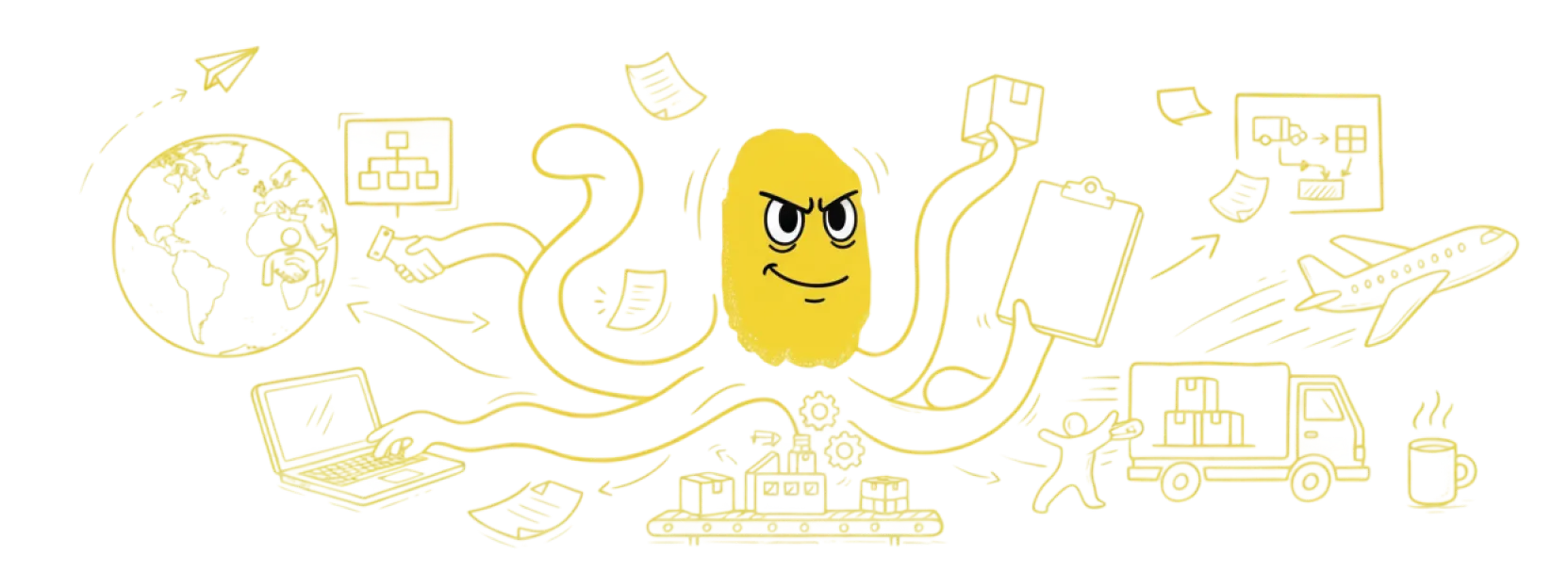
We're an outsourced, fractional sourcing and manufacturing department for consumer product brands. We get your stuff made in China. Think of us like the general contractor building your house. You talk to the general contractor, and they go figure out the best plumber, the best electrician, and the best framer to use. That's how we work. You come to us with what you need and then we go find the best factory for your specific product, matched to your size/scale, and then we run that relationship for you. Our US team collaborates with founders during normal business hours. Our China team is in and out of factories every day. It works best when you just treat us like an extension of your team. We handle product sourcing, sample development, factory negotiation, sub-supplier control, quality inspection, tooling, shipping coordination, and a whole lot more so that you can focus on sales, marketing, and scaling your business.
Founders who already have a working product, a working sales operation, and are out in the wilderness trying to manage their own China manufacturing. That's our sweet spot. Most of our best clients came to us because they were burning hours messaging someone named Cindy on Alibaba at 11pm, or they were getting poor results from their “guy in China" agent/freelancer, or they were with a trading company that kept moving production to different factories behind their back. If you're running an Amazon brand doing reorders on repeat, or you're a Shark Tank brand that needs to scale into retail, or if you've got five products and want a single point of contact instead of juggling five factory relationships...we're built for you. You focus on what you're great at and we handle the manufacturing side in China. That's the ideal partnership.[See: Am I too early to work with you?]
Our US team is based in Austin, Texas with an additional office in Grand Rapids, Michigan. Our China team is based in Dongguan. The structural reason this matters: US-based founders get to work with our project managers during normal US business hours instead of staying up at midnight trading emails with a Hong Kong trading company. Time zones are one of the most underrated pain points in direct China sourcing. We remove that pain by having a US-based layer on top of our boots-on-the-ground China team.
We've worked with 52+ brands to date, including a dozen Shark Tank companies. Our active client base spans pet products, outdoor gear, kitchen and baking, personal safety, audio electronics, packaging, kids toys, sporting goods, and drinkware. If you want references from a client in your category, just ask us on your discovery call. We're proud of our work and our clients are happy to vouch for us.


It starts with a discovery call. You tell us what you're making, how many you make per order or per year, where you're sourcing it now, and what you're hoping to improve. We ask a lot of questions. Then if there's a fit, we ask for files, samples, or whatever reference materials you have, and our China team gets to work identifying factory candidates. From there we pull quotes, review them with you, negotiate, and move into sampling. Once samples are approved, we run production, inspect, and ship. The whole arc from first call to first inventory on your doorstep varies by product, but for a reorder of something that already exists it can be as fast as 60-90 days. For new product development with tooling, it's usually 3 to 6 months.[See: How long does production take?]
Our north star is doing whatever's best for the founder and their specific product. We don't pick from a list of "preferred" factories. That's backwards. Our starting point is to determine what the actual best outcome would be without any constraints, and then we go out and find a factory that can actually make that happen. That's what’s best for founders, but it’s actually the opposite of how most factories work with founders. Many factories will tell a founder that a certain method is the best way to manufacture something, or that something cannot be done, but in reality their recommendation has more to do with what machinery they own. We've seen that movie too many times and it never ends well. We’re not a factory trying to maximize usage on our existing assets, we’re truly “founder first” and looking out for your best interests. Our factory matchmaking process considers your specific product category, materials, tolerances, volume, growth trajectory, and where you should be in that factory's client mix. The rule of thumb: you never want to be the factory's biggest or smallest client. You want to be in the upper third. Big enough to matter (which is useful when you need a favor or rushed production), but not too big that they can't handle larger order volumes as you scale
It depends on the product, the tooling situation, and whether we're making something brand new or reordering something already in production. A simple reorder of an existing SKU can go from PO to shipment in 20 to 60 days, plus another 10 to 45 days of freight, depending on if it’s sea or air. New product development with custom tooling typically runs 3 to 6 months from quote to first inventory. Pre-production prototypes or samples usually take 10 to 30 days once files/specs are locked and depending on the type of product.
GO Get made is a full service partner. We're not a find-a-factory-and-disappear kind of shop. Once you're a client, we take over the whole China relationship for the life of the partnership. What that actually looks like is a shared Slack channel with our US and China teams, weekly check-in calls, ongoing supplier optimization, and us proactively flagging issues before you see them. You shouldn't have to think about sourcing or manufacturing day to day. It should just happen. And when new product ideas come up, you just drop them in the Slack channel, our China team gets quotes, and we keep the factory options open so you can make decisions with real data instead of guessing.
GGM offers tailored strategies to help businesses scale effectively. Our team provides hands-on support, ensuring that your operations align with growth goals. We also assist with supply chain optimization to enhance efficiency and reduce costs.
Yes, and we'll come with you if you want. Nothing we do is a secret. You will always know exactly who the factory is. If you want to go to China and walk the floor, we schedule a factory tour. Here's the thing most founders don't realize though: even if you visit a factory in person, you have no idea what you're looking for. How do you know what a good factory or a bad factory looks like? You don't. But that’s where we come in. Our China team has a wealth of context from hundreds of factory visits, so they can tell right away. On factory tours they’ll point out all the important details for you. That’s what we’re here for. Doing a factory trip is great for relationship building and peace of mind, but the vetting is our job.

We don't have a public rate card because our model isn't fee-per-project. A lot of sourcing companies charge a fixed upfront fee of $3,000 to $5,000 just to find a factory, and once they collect, they disappear. That's not us. We make our money through a small margin built into the unit economics of what we produce for you, which means we only win when you're producing. The practical implication: we're not incentivized to find you a factory and bail. We're incentivized to help your business grow so we keep producing and scaling together for years. For most of our clients, the net result is that working with us costs them less than what they were paying going direct, because we're cutting their unit cost 15 to 30 percent through better factory matching, sub-supplier control, and real negotiation. When you get on a call with us, we'll walk through the specific economics for your product.
No, and this is actually one of the things that drives Eric crazy about how trading companies operate. The trading company game looks like this: they quote super low to win the order, and then on the back end they pile on fees. We don't play those games. When we quote you a unit cost, we walk through what's in it, what's not, and what the freight and duty situation looks like so you know your total landed cost. Any time a new cost shows up, we flag it in advance and explain why.
There's no hard MOQ set by us. We work at whatever scale makes sense for your business and then we go find a factory that matches your scale. But, there's an honest floor where the economics start to work, though: typically when you’re spending $100k+ per year on product. Below that, you're probably better off staying where you are until your volumes grow. The reason isn't us being picky. It's that factories have their own MOQs, and below a certain volume, the unit economics don't deliver enough savings to justify a switch. If you're not sure where you land, get on a call and we'll tell you straight.[See: Am I too early to work with you?]
No fixed fee. The full-service scope typically includes factory sourcing and matching, sample development and iteration, price and terms negotiation, sub-supplier component sourcing, tooling coordination, pre-production inspection, in-production monitoring, pre-shipment QC inspection, shipping and freight coordination, and ongoing supplier optimization. Some clients also use us for packaging design review, retail compliance prep (Costco, Target, Walmart), and product development sanity checks. If you want to scope something specific, ask. We don't have a rigid "tier 1, tier 2, tier 3" package because every client's needs are different.
It depends on where you're starting from, but we typically see about 20% savings. If we can save you 20% on the thing you're selling the most of, that's probably a pretty big number. The savings come from three levers: finding factories that aren't on Alibaba (lower cost basis because they're not paying for an English sales team or ad spend), taking control of sub-supplier components so you're not paying the main factory's markup on every input, and actual negotiation across the three stages of pricing. Unless someone wildly misunderstood something at the start, prices just go down from here
Ours to you, or ours to the factory? Both matter. For our clients, we're flexible and try to match the cash flow realities of your business. For the factory, we use our aggregate leverage (we send factories millions in orders across all clients) to negotiate better terms than a solo founder could. That usually means smaller deposits, longer net terms, and stretched payments. Payment terms are the second lever after price. A lot of founders don't realize that the terms themselves can unlock cash flow that's worth more than another 5% off the unit price. Our goal is to be as founder-friendly as possible with all payment terms.

You can, and most founders do. Here's what most founders don't realize... First, a lot of the "factories" on Alibaba are actually trading companies pretending to be factories. You pay a middleman markup, don’t have much visibility into where your stuff is actually made, and you still have to deal with late night calls to mediocre English speakers. Plus, even if you find a real factory, how do you know they're the right fit for your product and volumes? You don't. You're picking whoever shows up in search results. Lastly, the factories on Alibaba are only a fraction of the factories in China. They're the ones with English-speaking sales staff that can handle international export orders. The owners of those export factories drive luxury cars. Every product you order from them includes a small additional margin to pay for that English-speaking staff and the factory owner’s lifestyle.
But, there's an entire other pool of factories that serve the Chinese domestic market. They have the same machines and the same capabilities, but significantly lower costs. Those factories aren't on Alibaba because they don't have an expensive English-speaking sales staff. The owners of those factories drive economy cars. That’s the kind of factory we find for you.
Alibaba is fishing in a tiny pond. We tap into the entire lake.
A factory owns the machines and makes the product. A trading company is a middleman that sits between you and the factory. Trading companies are similar to us in structure but very different in practice. Most trading companies pretend to be factories on Alibaba. Even the ones that acknowledge being trading companies keep the actual factory's identity a secret. And here's the move that causes the most pain: they shift production to different factories behind the scenes to squeeze out extra margin, which is why your second production run doesn't look like your first. We're the opposite. Completely transparent. You will always know the actual factory, you can visit, and we don't move production without telling you.[See: Why not just find a factory on Alibaba myself?]
Honest answer: for most consumer product categories, it's not financially feasible. The US simply doesn't have the depth of raw material suppliers, production machinery, skilled workforce, or the cost structure to compete with China on most consumer goods. Even if you could find a US factory, your unit cost would be so much higher that you'd either have to charge a premium most shoppers won't pay, or take a margin cut that breaks your business. For the vast majority of consumer products we work with, it's nearly impossible for any country, let alone the USA, to compete with China's combination of low cost, fast production, and iteration speed.
Tariffs change the math, they don't flip the equation. Even with tariffs layered on, China is still the most cost-effective and fastest option for most of the product categories we work in. What tariffs do change is how aggressively we push on other levers. When tariffs went up, we spent more time finding lower-cost factories, squeezing sub-supplier components, renegotiating payment terms, and restructuring packaging to get more units per container. The savings we can find in those levers typically absorb the tariff hit. If tariff policy shifts dramatically again, we'll tell clients to reconsider. But pulling production out of China the moment a tariff headline hits the news is almost always a more expensive mistake than holding steady and optimizing.
China Plus One is a great strategy in theory. The caveats matter. First, scale. If you're not producing massive volume, there's very little benefit to splitting production. You might have to pay for duplicate tooling, which is expensive, and you lose economies of scale. Second, the math. 10,000 units in China plus 10,000 units in Vietnam costs significantly more than 20,000 units in China. Whatever geography you use as your plus one will be at least 15 to 30% more expensive. Then you lose bulk pricing on top of that. Third, for new product development, nowhere beats China. The depth of raw material suppliers and specialized factories means rapid iteration is much easier there. Infrastructure and industrial policy in other geographies are significantly behind China's. For the types of companies we work with, keeping production concentrated in China still makes the most sense. This advice could change if tariff policy changes, but today, that's the reality.
A few layers. First, factory selection. We only work with factories we've vetted in person and many of the ones we use already supply Costco, Target, or equivalent retailers, which means they already pass those audit hurdles. Second, sub-supplier control. If you go direct to a factory, you rarely think about who's supplying the batteries, the packaging, the electronic components, or other raw materials. The factory sources from whoever is convenient (sometimes a cousin's factory) and marks it up. We take control down to the sub-supplier level, which gives us tighter quality and better pricing. Third, in-person inspection. Our China team is in factories every week. Pre-production, during production, and pre-shipment. We’re the quality backstop
It's bigger than people think. Most of the people who "speak English" at Chinese factories do so at a very poor level. Even if you find a factory with a decent English-speaking sales department, there's still the cultural understanding gap. When an American says "high quality," that's a vague term based on reference points from US retail and social media. A Chinese factory worker has completely different cultural reference points, so "high quality" means something totally different to them. That's a huge source of frustration and quality problems for founders managing their own manufacturing directly with China. Our China team is different. They're fluent in English and they've all lived in the United States. They understand what American founders actually mean when they say "retail ready" or "Costco quality" or "clean unboxing experience." The constant collaboration between our US team and our China team makes sure the founder's vision gets translated to the factory floor correctly.
We think about factory pricing in three stages. Stage one is the stock estimate, which is the factory's opening offer. That's the number you get from a junior team that handles a hundred inquiries a month. There's always padding in there. Stage two is post-sample negotiation. Once we go through the sample process and the factory knows we're serious, two things happen. They want to win the business, and they've actually made one now so they know the real costs. We go back and say, now that you've made it, let's talk real numbers. That's usually where a chunk of the savings comes from. Stage three is ongoing optimization. As we place more orders, we're constantly pushing back. Can't improve the price? Give us better terms. Get the deposit down. Stretch out the payments. And we're constantly getting competing quotes from other suppliers to keep the current factory honest. Trust but verify. Our goal is to continually optimize and bring prices down over time.
You pay for tooling. You own it. We make sure the tooling ownership is documented in the factory agreement so there's no ambiguity if you ever want to move production. That last part matters. Tooling disputes are one of the ugliest situations in China manufacturing. Factories sometimes use tooling as a negotiating lever or drag their feet to keep the business. We've seen it. We plan for it up front. And for sensitive products, we sometimes split tooling across multiple factories to preserve leverage and protect IP.[See: How do you protect my intellectual property?]
Three layers. Layer one is factory vetting. We only work with reputable factories (many already supplying major US retailers), we visit them in person, we sign NDAs, and we check references. Layer two is economic leverage and ongoing monitoring. Our China team is in these factories every week, and because we send them millions of dollars of orders across multiple clients, they have zero incentive to risk the relationship by copying one client's product. Don't bite the hand that feeds. Layer three is legal and political backstop. We have relationships with law firms in China and with provincial and city government officials who want to shut down rogue factories that don't pay taxes or treat workers properly. Luckily we've never had to use layer three. On top of all that, for particularly sensitive products we also do production splitting, which is a whole separate answer.
Production splitting means we don't give a single factory the complete turnkey recipe for your product. Instead, we split production across multiple factories. One part at Factory A, another part at Factory B, final assembly and packaging at Factory C. No single factory has the entire process, no single factory has all the components, and no single factory could easily replicate your product if they wanted to. This is especially valuable for products with novel mechanisms, specialized electronics, or unique assemblies. It adds some coordination overhead, which is fine because that's literally what our team does every day. This kind of built-in IP protection is one of the biggest reasons clients come to us in the first place
Yes. We put an NDA in place for every new prospect before we dig into their files. We also get NDAs signed by the factories we work with for production. Worth being honest though: NDAs in China are useful but not a silver bullet. What actually protects your IP is the combination of NDA plus factory selection plus economic incentives plus production splitting plus ongoing monitoring. The NDA is the first box to check. It's not the whole answer
We are. Your contract is with GO Get Made, not with the factory in China. We're a US-based company (so we can't just disappear like a Chinese factory can), we're legally liable, and our reputation is on the line every time we ship. If there's a quality issue, we fix it at our expense. If there's a delay, we chase it. If there's a dispute, we handle it. We take IP and quality seriously because it's in our best interest. We wouldn't be in business long if we didn't deliver on those promises.

This is one of the biggest frustrations with how some founders approach China. You pay a freelancer $20 an hour and you think that guy works for you. Here's the problem. When you're sending a $100,000 order to the factory, the factory has a lot more margin available to pay kickbacks to that freelancer. Kickbacks aren't a normal part of business life in the United States, so this is a blind spot for American founders, but kickbacks are a way of life in China. Completely normal. If the factory is paying your guy more than you pay him, then whose guy is he really? On top of that, the freelancer lives in the same city as the factory and has much more daily interaction with them than with you. They're much more motivated to preserve that local relationship than the relationship with an overseas founder paying them $20 an hour. We have seen this play out too many times: the freelancer is actually doing what's in the best interest of the factory, not the founder.
If you're a Chinese-speaking, China-based operator who knows how to read a factory floor, then by all means go directly to the factory. You don't need us. But everyone else usually runs into the same four problems. First, you're only searching the English-speaking export factories, which is a small fraction of your real options. Second, the language and cultural gap causes real quality problems ("high quality" means different things to different people). Third, you have no control over sub-suppliers, so you're paying the factory's markup on every component and getting whatever input they felt like using that week. Fourth, factories tell you that certain things "aren't possible" when really the recommendation is based on what machinery they happen to own. Our north star is doing what's best for the product, then finding a factory that can actually perform. That's structurally different from a direct-to-factory relationship where the factory dictates what's possible
A transactional sourcing company treats finding the factory like the hard part. They charge a fixed upfront fee (usually $3,000 to $5,000), collect their money, hand you a factory contact, and disappear. We think that's backwards. Finding a factory is maybe 10% of the actual work of manufacturing a great product. The hard part is running the relationship, optimizing cost, catching quality problems before they turn into shipped garbage, coordinating sub-suppliers, and renegotiating as you grow. That's the 90% we do. And because we're in it for the long haul, we're much more selective about which factories we work with. A transactional sourcing company might funnel you to the cheapest factory that looks good on paper, because they get paid the same either way. We'd never put a client in a factory we know can't deliver quality on time, even if the initial quote is attractive. We're here for the next ten years of your business, not the next ten days.
Proceed with caution. Peer-to-peer factory referrals feel safer than Alibaba because they come from a trusted friend, but they're a near-miss in disguise. The problem: even if the factory is genuinely great for your friend, it's highly unlikely to be the best fit for your business. Factory matching depends on product type, order volume, growth trajectory, and a dozen other factors. The right factory for a $500K/year hardware brand is almost never the right factory for a $5M/year hardware brand. A peer referral skips the entire matching process and lands you with a factory that fits your friend's business, not yours. The friend meant well. The factory may be perfectly fine. It's just a structural mismatch problem. Happy to sanity check any referral you've received. Just ask.
If you're managing a direct factory relationship yourself, yes, you probably need one. Standalone QC inspection services (the ones that charge a day rate to send an inspector to the factory) are useful but they're only one piece of the puzzle. They catch problems at inspection time. They don't prevent problems, they don't fix sub-supplier issues, they don't renegotiate price, and they don't own the outcome. For GGM clients, inspection is already built into what we do. You don't need to hire a separate inspection firm on top of us. We got you.
Maybe, and we'll tell you straight. You're probably one step too early for our team if you’re still in the concept or prototype phase. Think of it like a relay race: product designers and engineers figure out how something should be designed and what the functional prototype looks like. Then the baton gets handed to us, and we take it from the ready-for-production stage into actual manufactured inventory. If you've got a janky science fair prototype that works but isn't refined, you're probably too early for us. We'll happily refer you to product designers and prototyping firms we know and trust, and we'll stay in touch so when you're ready, we're already familiar with your project. We also offer to sanity check stuff for you while you're talking to other vendors: "Hey, these guys are telling me X, Y, Z. Does that sound about right?" Happy to be a resource even when there's no deal.[See: Who is GO Get Made a good fit for?]
Complex is fine. A lot of our favorite projects are complex. For complex electronics and mechanical products, the process usually includes a longer sample and engineering iteration cycle, more sub-supplier coordination, and sometimes production splitting for IP protection.[See: How do you protect my intellectual property?]
That's actually one of our favorite setups and a major reason clients come to us. As businesses grow, they introduce more products, and most founders try to do everything through one factory because managing multiple factory relationships is painful. That doesn't scale. We use multiple specialized factories for different product types and handle all the coordination for you. It doesn't matter if you have one factory or twenty factories. We handle it all. You still have one US point of contact, one shared Slack channel, and one weekly check-in. Single point of contact on your side, a network of factories on ours.
Good, that's most of our clients. We've built rolling production cadences, pre-order mechanics, and flexible container planning for situations exactly like this. We'll typically set up bi-weekly or monthly check-in calls once a relationship is going, so we're planning 90 to 120 days out and adjusting in real time. If you sell out, we know about it before you do.
Yes, and this is a very common starting point for us. The key question is what your current tooling situation looks like, who owns it, and how much leverage you have to move it cleanly. Some founders prefer to move quietly. Others want to use the move as a Just make sure you avoid the "promise to change" pattern: you go to break up with your factory and they promise they're going to change and be better. Sometimes they do, most of the time you end up getting burned twice. We've seen both. We'll walk you through the tradeoffs based on your specific situation before you do anything.
We work primarily in consumer products. Strong categories include pet products, outdoor gear, kids toys, kitchen and home products, personal safety, sports and fitness, and electronics. We've worked on products ranging from injection-molded plastics to cut-and-sew soft goods to custom electronics assemblies. Categories we generally don't take on: consumables (food, supplements, cosmetics), regulated medical devices, and heavy machinery. If you're unsure whether your category fits, ask.
Book a discovery call through our website. The first call is usually 30 to 45 minutes and is genuinely a no-pressure conversation. Someone from our team will ask about your product, your current sourcing situation, your volumes, and what you're trying to improve. If it's a fit, we'll follow up with an NDA and ask for files, specs, or samples. If it's not a fit, we'll tell you straight and often point you to someone who can help. Either way you leave the call with more clarity than you came in with.
Nothing formal. Come with a description of your product, rough idea of your current unit cost and volumes, what you like about your current setup (if any), and what's frustrating you. If you have a sample, hold it up to the camera. If you have CAD files, we'll ask for those after the call, not on it. What we care about most on the first call is understanding the business, not running through a checklist. The more candid you are about what's actually broken, the more useful the conversation will be.
After a yes, the typical first 30 days looks like: NDA signed, files and specs shared, our China team identifies factory candidates, first-round quotes come back, we review them with you, and we start a sample run. After samples are approved, we place a first production order. We also set up a shared Slack channel with our US and China teams so day-to-day communication is fast and transparent. From first call to first container of inventory, most new clients are in the 2 to 4 month range for an existing product or 3 to 6 months for something that needs new tooling.
Please do. We regularly take calls with founders who aren't ready yet. We’ll tell you what you need before you're ready for production, refer you to the right product designer or prototyping firm, and offer to stay in touch. We’re happy to be a resource. Some of our best current clients first talked to us a year or two before they were actually ready.